Falling off at Brixton Rec. This is a very hard route, Narrow Right, British 6a?
Mike, la larva (The Worm) Lopera doing some 'buildering'. Que tripeo.
Saturday, February 10, 2007

Tuesday, October 17, 2006
A fast sloth!
The Roaches is one of the great four classic gritstone crags (the other three being Stanage, Froggat and Curbar). Its lower tier contains many true grit challenges, among them the super classic, and perhaps one the most famous roof climbs in The Peaks: The Sloth (5a HVS). A truly horrifying overhang with massive holds that is a must for any aspiring trad climber.
I had seen this route two years ago in my first visit to The Roaches, nobody was climbing it that day, and I could only dream of ever tackling something like that. But time passes by and we get stronger, and after having bagged one E1 and another E2, there was no excuse for me anymore not to do this route. So being at The Roaches again this weekend meant that I HAD to tackle it. I spent the whole Saturday morning pondering it, looking at it from far away, watching one candidate struggling and falling off, just to get back on and conquer it. What a route.
In the afternoon my moment of reckoning arrived, I had to do a route, and it was to be The Sloth or nothing. Like a doomed animal I approached the base of the climb, and slowly went up, getting closer and closer to the dreaded overhang. As it drew nearer, it became more and more terrifying, and my level of disbelief in myself kept growing and growing. Just at the bottom of the overhang there is a big 'cheese' block where one big sling can be put around. This is really sound protection, but being right at the bottom means that falling at the crux of the overhang implies a whipper and a big smash against the lower wall and ledge below. Indeed, stories abound about broken ankles and shattered egos, giving this climb a bit of a reputation.
At the crux point there is a wide crack where a bomber hexe can be placed, but you have to put this piece of gear while you are hanging in the 'sloth' position, while your strength is being drained away and your brain becomes increasingly unsettled. I tried three times to reach the crack to place the hexe, and three times I was unsuccessful and climbed down to the lower ledge. The fourth time would be the last try. My right arm was already pumped, and I would not have the strength for a fifth attempt. So it was all or nothing. Get to the top or fall down.
I took the biggest hex and put it firmly in my mouth, and set off to conquer the mighty roof. I tried to keep my concentration, placing my feet carefully, laybacking my way up the overhanging flake, jamming my left foot into a big block, and bridging with the right one. One pull up on my right arm and I was able to stretch and place the hexe, a truly beautiful placement. I kept my nerve and confidently took in some rope and clipped it to the newly placed runner. After that everthing happened in a flash. My left hand reached for the upper flake followed promptly by the right one. Big handholds kept appearing all the way, as I sprinted up. At the critical point I reached the famous upper crack, where a solid fist jam helps the final push. As I put my right fist into the crack it felt like melted butter, it wasn't going to hold, but I had no other chance. The hex at that point felt like it was placed miles below. With a final push of blind faith, I let all my body weight on the jammed hand, and thanks God, it did hold. My left hand finally reached the final jug and milliseconds afterwards I was finally over the roof, with my right knee firmly jammed into the upper off-width crack, panting like I had just ran a marathon. The rest of the climb was easy, and as I reached the safety of the belay, I could only gaze into the distance and admire the impressive view, the valleys bellow engulfed by the autumn mist. And there, relieved and happy for a job well done, you discover why trad climbing is so fascinating!
Yours truly on his little epic (The Sloth, 5a HVS):

Saturday, June 10, 2006
Fast Grip - E2!

I'm psyched. Last friday went to Avon Gorge, Bristol, and lead my first E2!!!! Fast Grip, a fascinating 5b that climbs for about 35m following a groove system that is poorly protected, the hardest move being an awkward mantelshelf protected by three very dubious micronuts, and then a 5m runout to the next peg! Highly recommended!
Sunday, February 26, 2006
Scottish misery
Some people argue that mountaineering is about pain and suffering, and that true mountaineers are those that can withstand or even enjoy miserable times in the hills. The week has just ended and I am back from a trip to Scotland, where I got more than my fair share of suffering, and I can truly say that I didn't enjoy it.
On Monday 20th February 2006, I headed with a bunch of friends to the North Face of Ben Nevis. We decided to tackle the classic, easy (grade II), Gully Number 2. We were pretty excited about the climb, and after about a 3-hour walk from the car park we were at the bottom of the gully, past a couple of climbers that decided not to go up for fear of avalanche. The snow was very soft that day, knee deep, very hard going. Nonetheless we headed up the gully, unroped. The couple decided to follow us after all. At the bottom a team of four German climbers just arrived intending to do the route as well.
The climb was pretty beautiful. We easily overcame a couple of small icefalls, and struggled a bit because of the strong spindrift. My french mate Pascal reached the top first. He stayed below the cornice waiting for me and our two friends to arrive. I was a couple of metres below him, when suddenly I started to slip. I tried to dig my ice axes firmly in place and kick my crampons in place but I kept slipping ... I looked up and to my horror I saw a crack developing and widening quickly on the snow all around me. The windslab I was standing on had collapsed. I managed to shout "avalanche" and a few milliseconds later I was sliding at full speed down this waste pipe of a gully. The Ben Nevis had flushed me down mercilessly. I slided very fast, trying to self arrest unsuccessfully. I kept trying until at some point I tipped over, my feet kind of stopping and my whole body whipping around, I started to roll wildly, hitting everything on the way down. The ride was so wild that I just thought that I would kill myself. Suddenly I stopped in the soft snow of the lower slopes, shaken but relatively unhurt. I lost both Ice axes. The four German climbers where still at the bottom of the gully and hadn't started climbing yet. They kindly came down to me, they had found one of my ice axes. They checked if I was ok. They draw my attention to two people further down the slope. My two friends had been avalanched as well! The German guys were pretty helpful and helped us down the slopes to the CIC hut. There we managed to recomposed ourselves and head back to the car park.
We found Pascal on our way down. We later lernt that the couple that was following us up the gully happened to be just below one of the little icefalls inside the gully and we just flied past over them! And it seems they didn't even realised! Went to the hospital in Fort William were we were checked over and found to be fine. We also lernt that the avalanche hazard for that day was grade 3 (considerable), with hight risk at North East facing slopes with unstable windslabs and snow over 900m, with special mention to gullies!
The rest of the week was filled with an easy traverse of a lower Munro and returning to Ben Nevis were Pascal and I tackled Castle Ridge (grade III). Beautiful but miserable. The wind at the top was hurricane like, and I kept climbing with visions of my body rolling down the hill and over the rocks, the snow slabs breaking underneath me! My biggest regret is that in these occasion I didn't manage to conquer the Ben's summit! I'll probably head back during the summer to do the easy 'tourist' route . . .
Gully Number 2 (red arrow) from the CIC hut:

The slab avalanche started near the top (top arrow) below the cornice, and I ended up well below down the lower snow slopes (bottom arrow)

About to be avalanched: looking down gully number 2

Saturday, December 31, 2005
Cacao e' Chuao
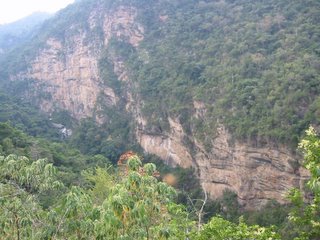
Durante la ultima semana de diciembre de 2005, Mike, Fuco y yo nos dirigimos al pintoresco pueblo de Chuao. A unas dos horas de caminata desde el pueblo, montana arriba, se encuentra una gran pared de arenisca (?) de unos 150m de altura, que forma parte de la garganta de uno de los tributarios del rio Chuao. En esta ocasion Federico tenia como proyecto encadenar en libre un enorme techo bordeado por una larga grieta (20m) en su base. La ruta fue preparada en artificial y Federico encadeno practicamente toda la ruta en libre exceptuando el paso crux justo al final, a un par de metros de la reunion.
La gran pared de Chuao vista desde el camino de aproximacion.
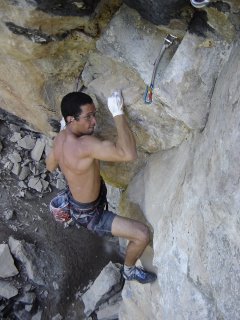
El Mike colocando una de las dos chapas en el inicio de la ruta. Esta seccion presenta roca descompuesta y poco posibilidad para colocar proteccion tradicional. Pocos momentos antes una de las piezas de proteccion fallo y Mike se dio un bollete bestial en el suelo, que resulto en una pequena fractura en la muneca derecha.

Preparando la ruta en artificial. Secciones de la roca estaban descompuestas, llenas de nidos de arcilla (avispas) o nidos de golondrinas. La proteccion fue dejada in situ para el posterior intento de encadenamiento en libre.


El Fuco despues del primer intento de encadenamiento en libre despues de un largo dia de preparacion de la ruta en artificial.

El Fuco en el crux. Una sequencia de slopers y dinamicos. Veredicto: 5.13a!
Er Fuco y su ruta ..., el gran techo sombreado que aparece en el centro de la foto.

Regreso a casa, el camion a traves de la plantacion de cacao.

La larva del Mikey y su ferula, despues de haber sido tratado por Flor Boscan.

Caco e' Chuao. (5.13a) Un solo largo de aprox. 30m. La primera seccion de escalada es de unos 10m hasta alcanzar la grieta y se proteje con dos chapas. La grieta se proteje con proteccion tradicional hasta alcanzar la reunion (dos chapas sin cadena).
La gran pared de Chuao vista desde el camino de aproximacion.

El Mike colocando una de las dos chapas en el inicio de la ruta. Esta seccion presenta roca descompuesta y poco posibilidad para colocar proteccion tradicional. Pocos momentos antes una de las piezas de proteccion fallo y Mike se dio un bollete bestial en el suelo, que resulto en una pequena fractura en la muneca derecha.

Preparando la ruta en artificial. Secciones de la roca estaban descompuestas, llenas de nidos de arcilla (avispas) o nidos de golondrinas. La proteccion fue dejada in situ para el posterior intento de encadenamiento en libre.


El Fuco despues del primer intento de encadenamiento en libre despues de un largo dia de preparacion de la ruta en artificial.

El Fuco en el crux. Una sequencia de slopers y dinamicos. Veredicto: 5.13a!

Er Fuco y su ruta ..., el gran techo sombreado que aparece en el centro de la foto.

Regreso a casa, el camion a traves de la plantacion de cacao.

La larva del Mikey y su ferula, despues de haber sido tratado por Flor Boscan.

Caco e' Chuao. (5.13a) Un solo largo de aprox. 30m. La primera seccion de escalada es de unos 10m hasta alcanzar la grieta y se proteje con dos chapas. La grieta se proteje con proteccion tradicional hasta alcanzar la reunion (dos chapas sin cadena).
Monday, September 12, 2005
El Naranjo

Last week we headed to Northern Spain, to the 'Picos de Europa' range (Europe Peaks). The most emblematic peak in this range is "El Naranjo de Bulnes", aka "Picu Urrielu", an impressive 500m high limestone monolith, with a summit reaching 2516m above sea level. My long time climbing partner, the crazy Frenchman Pascal, went down there with me to do the MarÃnez Direct, a long, but very easy route on the south face of the peak. The climb is done on superb, clean and hard limestone, along curious features called "canaletas", which are shallow grooves about 2 inches wide and 3 to 5 inches deep that have been carved by the action of running water on the limestone slabs. Highly recommended.
Sunrise and the hills around Naranjo:

Naranjo east face from the refuge:

Climbers on the east face:

South face:

First belay:

Summit:

Abseiling:

Approach path:

Friday, June 10, 2005
Separate reality, solo again after 19 years!

Separate reality, one of the most iconic roof climbs in Yosemite Valley, has had recently its second solo ascent. In 1986, the pictures of Wolfgang Güllich soloing this impresive, horizontal, 6m crack, hanging 200m above the Merced River went around the world. Hainz Zak, who shot Wolfgang's iconic pictures made the second ascent. More info here.
Monday, June 06, 2005
Wet Corner

I'm well on my way to becoming a bailing out expert. I did my BSc at Wye Valley, with One for All ... (5a HVS), when I had to bail out very close to the top because of nasty rain and a very, very slippery slab. Last Saturday was the turn of Cenotaph Corner (5c E1), a climb that needs no introduction. We arrived late in the morning at the bottom of the corner, after a nasty scramble on very slippery rock. The right wall of the corner was completely wet, in fact, a sort of subtle water fall. Nonetheless, I decided that after all the effort I had had to have a go at it. It seems that I didn't learn the lesson properly in Wye Valley. Anyway, a wet horrorshow ensued that left me hopelessly hanging from the middle of the climb. I ended wet, cold and numb, and with a well earned MSc on bailing out. Never try your first E1 in the rain! I am now looking for the PhD ...
Main wall of Angel Falls goes free!

Angel Falls, with its 978m drop, is the highest water fall on earth. Its waters fall along a massively overhanging, ancient sandstone wall. A team of British, Russian and Venezuelan climbers made a clean first free ascent along the steepest part of the wall. 31 pitches in total, with 9 graded E7, 19 days of climbing, 14 on the wall. No bolts or pegs left on the wall. More info at
http://climbing.com/news/venezuelarran/. Truly an amazing accomplishment!
Thursday, June 02, 2005
Coronation Crack
Last bank holiday weekend went for a hard sandstone double session - Harrison's on Sat and High Rocks on Mon. On Sat I sent my long stanging personal project: The Flakes, at 6a (or hard 5c depending on the guidebook), it is one of the true classics at Harrison's. Monday at HR was a crack jamming session, where I finally sent Coronation Crack (5c), probably the best hand jamming crack in Southern Sandstone! The best thing is that my long friend and climbing master Pascal couldn't do it! This is the first time ever that I beat him in a climb, which made me feel very proud, specially considering that it was his birthday!

During Monday morning it rained very hard, so the slabs at High Rocks were too wet to be climbed, so we settle for a little bit of music when the sunshine finally appeared.

At the end of the night we went to Pascal's house to celebrate his brirthday. Pascal got a bit pissed and afterward tried to eat one of his kittens!

During Monday morning it rained very hard, so the slabs at High Rocks were too wet to be climbed, so we settle for a little bit of music when the sunshine finally appeared.
At the end of the night we went to Pascal's house to celebrate his brirthday. Pascal got a bit pissed and afterward tried to eat one of his kittens!
Wednesday, May 18, 2005
Brixton guidebook
Yes, Brixton Climbing Wall, the most daring of all London Crags has got its new guide book, with a complete description of all the amazing routes available! The guide is not properly finished yet, but you can have a look at it here! Read it, use it, and leave your comments.
Monday, May 09, 2005
Basset's Farm

The Garden of England
On Sunday I headed back to southern sandstone, this time with my old friend Pascal, and Jonathan a quite nice American chap. This was our first time at Basset's Farm, and to be honest this crag is set in the most breathtaking scenery of all the other sandstone crags I have visited so far (and that includes Harrison's, High Rocks, Eridge, Bowles, Bulls Hollow, Stone Farm and Under Rockes), here you are literally climbing in a beautiful garden. It is a very small crag, but with impressive and very technical climbs all above 5c in its main wall. This crag is certainly worth a visit, specially if you are a strong climber wishing to get away from the crowds!
The main wall

Pascal monkeying on Tree Route (4a)

Jonathan resting

Anaconda squeeze!

Duncan pretty happy stuck inside Anaconda Chimney
Last Saturday we headed to High Rocks, where the restoration project has had a profound impact on the quality of the climbs. The highlight of the day was Anaconda Chimney (4a), a very long, narrow, exhausting and brilliant climb! A serious contender for the best chimney climb in Britain? We also tried two of the most immaculate arêtes in Sandstone: Henry The Ninth (5b, right of Infidel) and Advertisement Wall (5b, left of Engagement Wall, see pics bellow), both very technical and balancy. James, Tobby and Duncan performed superbly on Engagement Wall (6a). Other joys of the day where the jamming cracks Lucita and Marquita (both 5c), Coronation Crack (5c) a true classic, that deserves 4 stars and that I haven't been able to manage yet, Dirty Dick (4a) which is a nice route to solo, and Infidel (6a), a very technical climb that regrettably none of us manage to climb!
Patrik on the superb Engagement Wall

James on Infidel

The climbing maniacs: James, Ines, Duncan Geraldine, Caroline, Tobby and Mario

Tuesday, May 03, 2005
Yorkshire grit ...

The famous Yorkshire dales were our destination for last bank holiday weekend. We did a nice walk along the cliffs and gorges of Malham, practiced some fine bouldering at Caley, had a crack hell experience at Briham Rocks, and enjoyed a sunny and warm day of relaxed bouldering and top roping at Almscliff.
James attempting Otley Wall (V3) at Caley Crag

Success on Chicken Heads (V2)

Caroline battling with the Chips (V0-)

Geraldine testing her boots on an unknown friction slab (V1)

The climbing crew: James, Geraldine, Duncan, Caroline and Mario

Tuesday, April 26, 2005
Bowles again ...
Well, we decided to head back to Bowles Rocks last weekend: James, Ana (my girlfriend and official photographer for the session) and Ines. Tried Fandango (5c) unsuccessfully, which feels desperately hard for a 5c. It is rumored that one of the bottom holds broke off and that would explain why this climb feels rather like a 6a. We also climbed the classic Sapper (4b), James and I did the Inspiration variation of the climb (5b) and Ines did the classic route. An unforgettable squeeze. Also tried Abracadabra (5a), one hell of a crack; Patella (6a), again unsuccessfully; Ly'in (6b) which I wasn't able to do (arggghhh), I keep falling at the crux but the bottom moves now feel much easier, James sent it again, officially redpointing it first 6b (last week he had actually done a bit of hangdogging); and finally we tried Ricochet (4b) which has a very tricky start and some delicate route finding, nice 4b! Next week we are planning to go to Yorkshire and try some hard grit, so see you then!
Having fun in Fandango:

Having fun in Fandango:
Monday, April 18, 2005
This is a big number:

This weekend we had one of the most amazing climbing we have had this year at Bowles Rocks. James, Geraldine and I headed down to this beautiful climbing spot south of London, where we enjoyed the weather and some quality sandstone.
Our first climb of the day was Mick's Wall (5b), and awkward crack I onsighted easily but that took James unaware. He sent it in style after a series of failed attempts which made him improve his jamming technique the hard way. We next tried Mick's Wall Variation (6a) where I failed miserable. James showed a much better performance here but he found the top moves too hard to tackle.
Mick's Wall Struggle:

The great project of the day was The Banana (6a), climb we tried unsuccessfully a couple of weeks ago (see previous posts) and that we sent at our FIRST try this time. We can barely believe the top mantleshelf felt so easy this time! This is my first British 6a.
We then move onto Patella (6a), certainly much harder than Banana. Although neither of us could do the final couple of moves (argghhh!!!), we felt really satisfied we our performance here. This route is amazing I am confident we will be able to handle it in a couple of weeks!
The climbing for the day was going on far better than what we would have ever expected, but things were going to get even more exiting. There were a bunch of meaty hardmen trying impressive boulders in the Fandango wall. They moved later onto Ly'in slab (6b) which simply looks impossible. We watched them trying and failing again and again, and we dreamt about the day when we could tackle climbs at that grade.
After a good rest and after enjoying the hardmen show, we moved onto Pig's Ear (5c) and Pig's Nose (5a) two truly sandstone classics at their respective grades. Pig's Ear involves climbing on a shallow and flaky slab to reach an awkward overhang. This climb took a good couple of tries but we finally managed to send it. Pig's Nose, well, we simply flew past it! I had tried this climb some 3 years ago and its final, steep overhang felt so impossible!
Having fun on Pig's Ear:

Relaxed, and happy after such an amazing day, we started gathering our things before deciding whether to go home or do a little bit of light bouldering. We then passed again in front of Ly'in slab where a couple of guys where trying it unsuccessfully. When they were done and retrieved their ropes, I got onto it and tried the first couple of moves. Ummhh, it looked doable after all. James was getting exited and enticed me to put the rope up. He tried first, reaching for the first horizontal set of finger holes, and pulling real hard on them before stretching and reaching the second set, which is miserably smaller. James spent a good 5 min there trying to work out what to do next until he finally decided to traverse to the arete and finish up an easier route "this is too impossible man". I went up it, exited about how a 6b slab should feel. I managed to arrived at the second set of finger holes awkwardly, and started playing with them, trying to visualize a way to move forward up. I found a small mono for my left index finger, big enough for the first phalanx of my finger to go in. Gathering strength from where I didn't have it, I pulled hard on the mono, move my feet as high as possible, whole body under tension, and reached high up with my right hand to a miserably side pull sloper. Impossible. Went down the climb, taped my fingers to prevent injuring the pulleys and went up again. I repeated the same hard pull on the mono, but this time paid more attention to my footwork and reached further high up with my right hand to the upper ledge ..., I actually managed to touch the lip of the ledge before all my strength abandoned me and my body detached itself from the slab. Impossible is nothing, this is doable! "James I know you can do this!" He got really exited, so we swapped rope and belay and he went up it quickly. He performed his own version of the moves I had worked out and he actually managed to reach the upper ledge! Unbelievable, he had simply tackled the 6b crux of the climb! Despite James's phlegmatic character, I could see happiness pouring all over his face.
6b Glory:

I certainly wasn't going to give up that easily so I had another couple of goes. These later attempts where not as good as the first ones (argghhhh!). I went down the climb feeling a bit disappointed, but hey, a first 6a and 6b the same day? Not even in my wildest dreams! No worries, I'm sure next time I'll do this climb easily ...
Well done James!
So close ...

Monday, April 11, 2005
Cracks and Flakes!
For years I have heard my French friend Pascal talk about a hard climb called the 'flex' down at Harrison's Rocks. He would mention this climb again and again, and how he would try it every New Year's Day, sometimes successfully, sometimes failing miserably. I was intrigued by this climb's name. I would try to imaging its crux sequence involving some 'flexy' moves. Last summer Pascal showed me the climb, and after checking the guide book I realised that it is called 'The Flakes' (6a), and the climb itself involves a rightwards traverse using a series of flakes and a very hard move pulling over an overhang to gain the top. Last Saturday I went with my climbing mates James and Geraldine to Harrison's and had a go at it. None of us could handle the crux moves but nonetheless were satisfied by our performance. I reckon that a couple of weekends more and we will be able to handle it!
Yours truly hanging onto the Flakes:

Jame's Stupid effort:

Another crazy climb we tried was 'Stupid Effort' (5b), to be tackled with one of the most wicked sequence of moves I have seen in a climb at this grade. The above pic shows James sending the crux slab, involving a mantle shelf for the left arm, a tiny sloper for the right hand and an awkward stretch for the left leg!
Geraldine getting 'high' up onto Stupid Effort:

Other highlights of the day included the savage 'Slimfinger' (5c), and the squeazy peasy 'Long Crack' (4b), the latter one a true classic, where inproper offwidth technique can take more than one experience climber into an unexpected struggle.
Yours truly hanging onto the Flakes:
Jame's Stupid effort:
Another crazy climb we tried was 'Stupid Effort' (5b), to be tackled with one of the most wicked sequence of moves I have seen in a climb at this grade. The above pic shows James sending the crux slab, involving a mantle shelf for the left arm, a tiny sloper for the right hand and an awkward stretch for the left leg!
Geraldine getting 'high' up onto Stupid Effort:
Other highlights of the day included the savage 'Slimfinger' (5c), and the squeazy peasy 'Long Crack' (4b), the latter one a true classic, where inproper offwidth technique can take more than one experience climber into an unexpected struggle.
Subscribe to:
Posts (Atom)